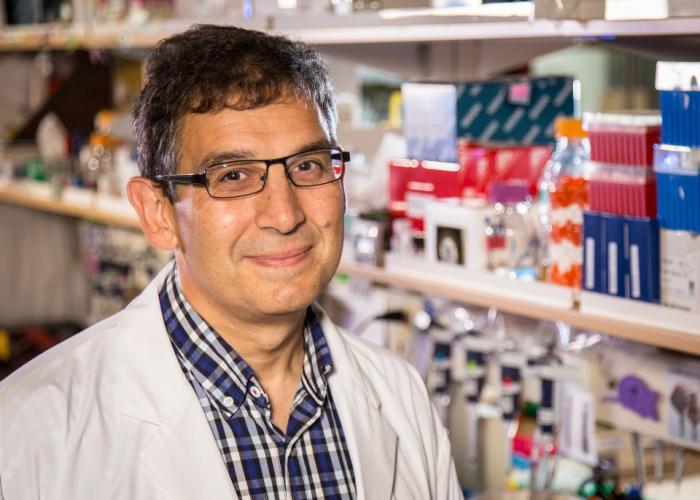
Dr. Samuel Aparicio, distinguished scientist at the BC Cancer Research Institute and professor at the University of British Columbia, is co-senior author on a recent paper providing the most detailed map to date of how breast tissue changes over a woman’s lifetime, revealing the role of menopause in cancer susceptibility. The study was co-led with scientists at the University of Cambridge.
Published in Nature Aging, the paper is titled Single-cell spatial atlas of the aging human breast. The study reveals that as women age, breast tissue undergoes major changes – including declines in cell numbers and proliferation, structural shifts and alterations in the immune environment – that together create the conditions more favourable for cancer development. Notably, the most dramatic changes occur during menopause.
“We’ve previously seen that age dependent changes in oestrogen activity occur strongly in milk secreting cells of the breast and now we can see the surprising extent of changes in all cell types, including the immune system, with age,” says Dr. Aparicio. “We are now seeking to understand the relationship between changes in immune cells and surveillance of early mutations that can arise in milk secreting cells over time.”
This work was made possible with generous funding support from the BC Cancer Foundation, the Terry Fox Research Institute, the Breast Cancer Research Foundation, the Canadian Institutes of Health Research, Cancer Research UK, UK Research and Innovation, the Vanderbilt Medical Scientist Training Program and the Canada Foundation for Innovation.
Congratulations to Dr. Aparicio on this publication!
This writeup has been adapted from a University of Cambridge media release: Most detailed map to date of breast tissue changes reveals role of menopause in cancer susceptibility